Monday, February 02, 2009

Choosing a venue

What is it with tech people? For the fourth time this month I've been to a totally inappropriate venue for an industry function.

The strangest thing is how organisers keep picking expensive, fashionable bars. All of this is fine if the organisers are paying. However it's a usually a pay bar so it's the guests who pay for the organiser's bad choices.

Sometimes the organisers stump up some cash. One event I went to a few weeks back the organisers stuck $500 in the pot.

Because they chose one of the most expensive in town the tab ran out in less than half an hour, leaving guests presented with fat bills for their beers.

The one I went to tonight was a doozy. Not only did they choose an expensive bar, but it had no draught or cheap beer. Expensive imports only.

But the kicker was the bar was a disused bank vault. Perfect for demonstrating wireless broadband applications.

You've gotta wonder.

Sunday, November 23, 2008

The Julie Amero disgrace ends

Rick Green of the Hartford Courant reports Julie Amero pleaded guilty to a reduced charge to settle the matter against her.

Everyone involved in bringing these charges against should hang their heads in shame.

The people of Connecticut should also be very concerned about the calibre of the people running the state's schools.

What is probably the most disappointing of this entire disgrace is how a poorly trained teacher was victimised by the people trusted to protect her and her pupils.

It's instructive that no other charges have been laid against her superiors who were responsible for the pornography getting on the computers in the first place.


Wednesday, September 03, 2008

Google Chrome

I'm typing this on Google Chrome, their new web browser. 

So far, so good except for it crashing the first time I opened it.

We'll see how this goes over the next few weeks.

Wednesday, August 27, 2008

Another UK data blunder

I'm truly amazed at the latest UK data blunder where a second hand server was sold on eBay containing over a million banking records.

What is it with the UK and computer records? The Guardian has a list of NINE major blunders in the last twelve month.

Now it is possible that UK corporations are a bit more open about the problem than their overseas counterparts, but I somehow doubt it.

The big lesson from this particular debacle is that you have to wipe your computers before selling them on eBay or giving them away to your friends.

One big trap is returning computers to leasing companies as Paul McCartney found a few years back. You need to totally wipe any important data before returning the computer to the bank or finance company.

A free program I like for doing this is the Heidi Eraser program. It's a relatively easy to use tool that wipes free space on the drive or the entire drive should you so desire.

We have instructions on using it on our IT Queries website.

If this is too hard, then we have our own service where a tech can do this for. Most other IT services companies can do it too.


Friday, August 08, 2008

Commander appoints administrators

On my Australian Technology Blog I commented about the problems of Commander Communications last January. I thought they were doomed at the time and said so.

Today they appointed official receivers for the business.

In the last month we've seen the collapse of the Bill Express empire as well which has been well documented in Mark Fletcher's Newsagency Blog.

The sad thing is both of these businesses had great propositions; Bill Express' network of newsagents and Commander's taking over of the old Telstra small business systems were fantastic assets.

I suspect in both cases the problem was easy money. While the tide was rising bad managers could make bad decisions and get away with it because there were always willing lenders and investors to cover the costs of those mistakes.

Now the tide is running out and money is tighter we see those business suffering.

In the tech sector, companies like Commander and Bill Express are the just the beginning. There's a lot more that are going to be found wanting.

The good managers should be looking at their costs and funding right now. If their business units are not making a profit then it's time to ask some serious questions.

Monday, July 21, 2008

Apple resellers are not learning

With the new Apple store open in Sydney it's amazing the existing Apple resellers are still messing around their customers.

In an article in today's Sydney Morning Herald Dan Kaufman describes his saga of transferring data from an old Windows system to a Mac.

Now transferring data to a new computer can be fiddly. I spent 4 hours doing what was a straight forward copy from an XP system to a Vista box last week.

Copying between Windows and Macs can be even more tricky, as Dan found with the rigmarole of importing Outlook data into Thunderbird, then copying the mailboxes to the Mac and finally importing them into Mac Mail.

Fiddly, time consuming and irritating but doable. If things go well.

When things go wrong, it can get ugly. In Dan's case his Mac Mail refused to work.

This should have been a relatively easy fix but instead his local Apple reseller turned it into a refund issue, first telling him he could return it and then telling him tough luck.

All along, a knowledgeable tech could have identified the problem and resolved it quickly.

It really surprises me Mac resellers haven't lifted their game since the opening of the Apple store.

Friday, July 04, 2008

Grisoft's link scanning mistake

It's funny how anti virus companies seem to lose the plot so comprehensively. Over the years we've seen this with Norton, McAffee and now Grisoft, the makers of AVG.

AVG Free has been a favorite of ours. I've recommended it to thousands of people and happily used it myself.

But the Link Scanner function has upset a lot of people. For users it can slow web pages down. Australian web surfers have an additional problem in that it can boost traffic and take some users over their download limits and hit them with big bills.

For webmasters, the problem's even worse. It means websites can be tied up by excess traffic and messes up their access logs.

To compound the problem, AVG's response is pretty arrogant. Sure you can't make an omlette without breaking eggs, but this is an egg fight in the kitchen.

I've posted a fix for the problem on our IT Queries site, but it's an irritating issue.

This is a serious PR problem for Grisoft and they need to swallow their pride and put out an update that modifies the link scanning feature before they damage their brand any further.

Thursday, June 19, 2008

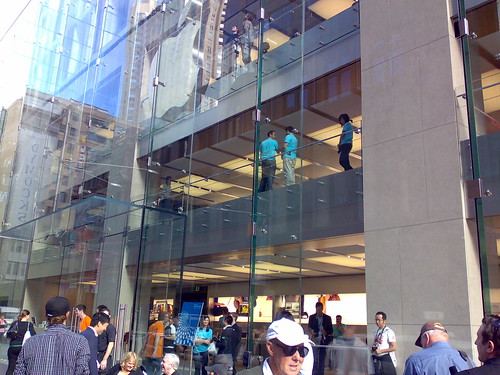
Sydney's new Apple Store

Sydney's new Apple store is impressive. A year back I wondered how the existing Apple resellers will survive when it opens.

My view now is they won't. The level of service is several steps above what they offer and it's difficult to see how they can compete.

Interestingly, I also thought Bondi's Academy Mac reseller would probably survive the Apple store onslaught. Sadly, it didn't make it to the opening.

The real challenge now is to the other brands. This flagship store really makes raises the bar for the other vendors. It's going to be interesting to watch how this develops.

Tuesday, June 03, 2008

OECD finds spyware

It's great to see the OECD is on the ball.

Ten years after spyware started appearing and eight years after it started reaching epidemic proportions, the OECD calls for greater co-operation across the various international communities addressing malware.

To call this shutting the stable door after the horse has bolted is an understatement.

The OECD are suggesting it might be good idea to check the stable door after the horse has vanished over the horizon.

It's unfair to pick on the OECD though, government inaction has been notable throughout the whole spyware debacle. You can only wonder how much of the whole sordid business would have been stopped had governments spent a fraction of the effort they've spent criminalising copyright infringements.

What really surprises me is the claim 25% of US computers are infected with malware. This strikes me as high and I suspect the real number is around 10% with half of those serious infections.

Where I do agree with the OECD is the criminal element has taken over from the backyard script kiddie. This is more reason for governments to start acting.

Saturday, April 12, 2008

The first sound of web 3.0

Is web 2.0 coming to an end? This morning I see the first mention of web 3.0.

http://darmano.typepad.com/logic_emotion/2008/04/the-top-10-made.html

Ther real question is how the end game is going to play out for web 2.0. My guess is the credit crunch means funding will dry up for the freesphere and a lot of business that didn't add value won't survive.

Interestingly, Fred Wilson had a comment about this a few days ago.

My guess is we are coming to the end of the web 2.0 mania, so preparing for the next wave is a good idea.

Sunday, March 09, 2008

Mac Office

I've been writing a review of Office 2008 for the Mac for SmartCompany over the weekend. While I'll spare the details of the review for their site, one thing that did leap out at me is the better integration of the Mac version over the Windows version.

Microsoft's Mac business unit seems to get this right in a way Microsoft's other divisions often don't.

Another thing I note is there are only three versions of Office for the Mac as opposed to the ridiculous seven on the Windows version.

It's funny that Microsoft seem to be doing a better job on other people's operating systems than on their own. I'd love to see what they could do with an Office for Linux product.

Wednesday, February 27, 2008

The curse of the free revisited

The Freesphere has been bugging me for a long time. For the technology and publishing industries it's a major challenge to see how we are going to make money out of the services people are increasingly expecting to get for free.

Fred Wilson has a challenging blog entry on his VC blog on how it can work, he also links back to Chris Anderson's latest entry in Wired.

The fallacy in all of this thinking is that free is not the entire business model. Fred himself admits in his blog comments that of the businesses he's invested in "none use it as a primary business model but many use it as a part of their business model".

Chris confuses things in his Wired piece by comparing the Freesphere with the razor blade business model where the razor is sold cheaply, or given away, and the money made on the blades.

That business model is valid and works, but it's not comparable with the current free mentality on the Internet: You might be giving away the razor for free but your customers are getting their blades from the guy up the road whose business model is the exact opposite of yours.

In fact, Chris even touches on why the Freesphere model fails by mentioning how King Gillette was unsuccessful selling his razors below cost to the Army and banks in the hope soldiers and customers would like the product and be prepared to pay for it.

That's exactly the model many of today's free services use without success. We see Yahoo! fighting for independence, the New York Times laying off hundreds and even Google's share price fell today on fears the ad revenue that underpins the free services is threatened.

The simple fact is Milton Friedman was right; there is no such thing as a free lunch. Someone, somewhere pays.

Until now it's been willing investors that have picked up the tab. If in the new era of scarce and risk adverse capital we find investors are no longer prepared to pay for providing this free stuff, then a lot of people are going to have to get used to paying for things again.

Giving away products for free can be good marketing, and there's nothing new there, but simply giving everything away for free isn't the recipe for a successful business.

Sunday, February 24, 2008

email ettiquette

It's funny how we get a stupid email story almost every 12 months.

The last big one was fourteen months ago with the Kiwi event manager that called a prospective customer’s wedding “cheap, nasty and tacky”

This week we get a Brisbane restaurant that dismissed a customer's comments with a "Your are an idiot we don't want your feedback."

It's bad enough it made the Brisbane newspapers but it also made the Consumerist website. This really is publicity you cannot buy for all the wrong reasons.

Once again, the moral is "think before you send."

Monday, February 18, 2008

IT Wire jumps the shark

Jumping the shark refers to the Happy Days episode where in a desperate attempt to boost flagging ratings a waterskiing Fonz jumped over a shark.

It's quite clear Alex Zaharov-Reutt and IT Wire are doing the same thing with their "Mac invulnerability bubble to pop in 2008?" article.

Apart from the fact the story's based on no objective evidence whatsoever, relying on a press release written around a user poll conducted by an anti-virus company that even the authors admit "is not scientific", this article is simply nothing but Digg bait.

I could give Sophos a serve too for peddling this hype, but I'm simply sick of ranting about the tactics of the peddlers of Windows security software.

It's understandable Alex would try to drive traffic to his blog with this sort of inflammatory tripe given the revenue sharing basis ITWire writers have with the publisher.

That might help Alex's bank account today but he should remember that in the long term the only currency any of us writers have is credibility. Posting junk like this doesn't help his or IT Wire's.

Saturday, February 16, 2008

Simply Selling

Computer retailers and vendors have to simplify their product lines and marketing. It's too complex for the average buyer.

Our radio show a few weeks back had quite a few callers distressed at the difficulty to buy a computer. Then an article crossed my path that mentioned business owners and managers are struggling with the same thing.

I found how hard this was first hand over the weekend when I looked at tablet computer options for a client. It's simply amazing how difficult vendors make it to research this stuff.

A special mention in these stakes has to go to Toshiba. Don't get me wrong, I like Toshiba laptops and their warranty is the best on the market. However their website and product code numbering is simply brain damaged and leaves one rushing to Dell or Lenovo.

Retailers, service providers and vendors make it too hard for buyers. Not only are there too many options, but they are dressed up in arcane terms. All they do is confuse shoppers.

It's tempting to go back to the Henry Ford line of any colour as long as it's black. Apple almost do this, for instance the Macbook Air comes in two basic models but even they lose the plot as we see with the five hundred flavours of iPod.

The industry needs to go back to basics and focus on what the consumer wants; simplicity. Believe it or not, they would actually sell more product.

Tuesday, February 12, 2008

Web 2.0 blues

One of the problems I see with web 2.0 apps is the requirement for them to be "always on". System hiccups are simply not an option.

Today we see outages with Blackberries, Gmail and Salesforce. No doubt thousands of users of all these services have had a frustrating day.

If web 2.0 is really going to revolutionize business applications as its boosters claim, then we'll need the services to be far more reliable.

Trend Micro joins the AV hall of shame

If you needed an example of why you shouldn't trust computer reviews, I stumbled on this gem in Australian IT this morning.

The reason it raises my ire is that I was at client's site last night where a spyware scan came up with ten separate spyware infections, including oldies like Cool Web Search and 180 Search Assistant.

That client was running an up to date, fully patched Trend Micro 2007 security suite.

Roland Tellzen, the AustralianIT writer, gives a computer security suite that doesn't detect the most common spyware a 75% mark because;

"Installation is clean and straightforward. It took less than 10 minutes to install and activate, and the user customisation screens are well-designed and user-friendly."

All fair reasons, except the thing doesn't do what it's supposed to.

I guess it's no surprise we learn today that Trend Micro is suing ClamAV for alleged patent infringement, it's so much easier to sue people than do hard work like release products that actually work.

Tuesday, February 05, 2008

HP is a joke

Two hours to install a printer?

Idiots.

Vista service pack 1

Microsoft have released service pack 1 for manufacture which means we'll start seeing this on the shelves in the next few weeks.

The download center won't have it available for six weeks so we won't be seeing it on client computers for a while. This is a handy gap for us techs to get our heads around the changes before it's unleashed on the general public.

The next three months will be the make or break time for Vista; this service pack has to deliver the performance improvements if Vista is to shake the slur of being the "new Windows ME".

For the moment, we'd recommend holding off Vista even with the service pack until we've had an opportunity to evaluate the changes and identify potential problems.

More on our PC Rescue website.

Monday, February 04, 2008

Internet Explorer strikes again

The Active X flaw in Facebook and Myspace is another example of why you should not use Internet Explorer for day to day websurfing. Once again we see why using Firefox or Opera is essential for safe computing.

Another issue raised by this bug is that people are too quick to install Facebook apps, not to mention how much junk appears on the typical 13 year old's MySpace page.

The only thing that really surprises me is this doesn't more often.

If you are using Facebook or Myspace, avoid using Internet Explorer.